Blobfish: 2025 Fish of the Year and "World's Ugliest Animal"
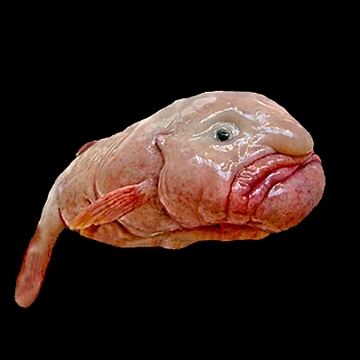
Photo: Blobfish Out of Water with Its Body Collapsed
Contents
What is a Blobfish?
The blobfish (Psychrolutes marcidus) is a deep-sea wonder that won the title of "World's Ugliest Animal" in 2013, and was recently crowned the 2025 Fish of the Year because of its many unique characteristics. The blobfish has a gelatinous body that is uniquely adapted to survive the extremely high water pressure of its deep-sea habitat that would easily crush a steel submarine. In its natural habitat—600 to 1,200 meters (2,000 to 4,000 feet) below the ocean surface, the blobfish resembles a typical fish. However, when brought to the surface, its lack of bones and very low muscle mass causes its body to collapse into a formless, "blobby" mass, earning it its name—Blobfish.
Fast Facts about the Blobfish:
- • Appearance: Pinkish-grey with a bulbous head, dark eyes, and a large, down-turned mouth.
- • Adaptations: Composed of jelly-like cartilage less dense than water, it stays buoyant without a swim bladder, which would implode in the deep.
- • Lifespan: Recent research suggests blobfish can live up to 130 years.
- • Status: Voted 2025 Fish of the Year in New Zealand, the blobfish is considered a vulnerable species due to deep-sea bottom trawling.
- • Blobfish Size: It is typically around 30 cm (1 ft) in length and approximately 2 kg (4.4 lb)in weight.
- • Deep-ocean pressure: The water pressure in its natural habitat is dozens of times greater than at the surface. When blobfish are removed from this high-pressure environment, their bodies expand and lose structural integrity giving them the "world's ugliest animal" look.
The Sad Story of Mr Blobby – Winner of the Ugliest Animal Award

Photo: Blobfish - World's Ugliest Animal?
Mr. Blobby was a blobfish caught in 2003, approximately 1,300 kilometres off the coast of eastern Australia. Based on photographs of Mr. Blobby, the blobfish was voted the "World's Ugliest Animal" in 2013. While the contest wasn't entirely fair (since Mr. Blobby was dead and out of water), the Ugly Animal Preservation Society had good intentions. The aim was to raise awareness of endangered animals that don’t often capture the public’s imagination because of their "unattractive" appearances.
Mr. Blobby measured 28.5 cm in length and weighed 1.7 kilograms. Although referred to as Mr. Bobby, it is unknown whether this fish was male or female, as its gender was never confirmed.
Mr Blobby had his "fifteen minutes of fame". He was an overnight media sensation. Today, he sits alone on a shelf, preserved in a jar of 70% ethyl alcohol, in the Australian Museum. He no longer looks like his famous photos. His skin has tightened, his eyes sunken, and his distinctive nose has shrunk—poor Mr Blobby.
Blobfish In Water

Photo: Blobfish Swimming Underwater
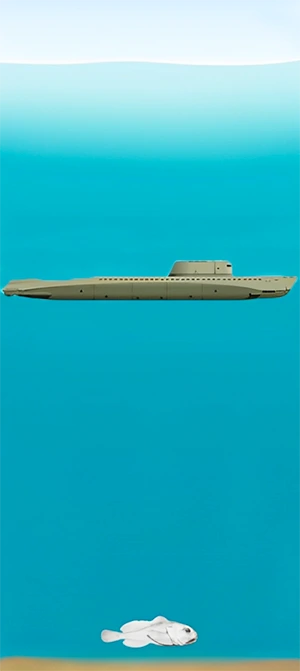
Photo: Depth At Which Blobfish Live
The blobfish lives at depths of 600 to 1,200 meters (2,000 to 4,000 feet) below the ocean’s surface, where immense water pressure keeps its body in its natural, tadpole-like shape (see underwater photos). This high-pressure environment allows the blobfish to maintain its unique, gelatinous structure. However, when it’s brought to the surface, the pressure drops substantially, and its body collapses into a gooey blob, earning it the title of the “world’s ugliest animal.” (Learn more about this phenomenon below.)
Did you know the blobfish thrives at depths 2.5 times greater than the deepest diving submarines can reach? If a submarine attempted to go this deep, the water pressure would crush it. But for the blobfish, this is just another day in its natural habitat.
The Blobfish Out of Water - Explained
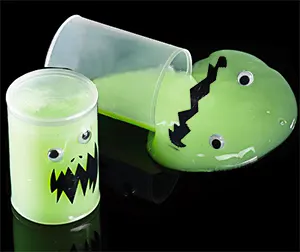
Photo: How a Blobfish's Body Maintains Its Shape
Ever wondered why the blobfish looks perfectly normal underwater but turns into a gooey blob when brought to the surface? Here’s why.
Think of slime—the gooey stuff kids love to play with. When it’s inside a container, the sides of the container apply pressure on the slime, helping it keep its shape. Similarly, the immense pressure of the deep ocean acts like a container, holding the blobfish’s body in its unique, gelatinous form.
But when the blobfish is brought to the surface, the pressure drops significantly, and there’s nothing left to hold its body in shape. As a result, just like slime outside its container, the blobfish’s body collapses into a soft, shapeless blob. Essentially, the blobfish is built to thrive under pressure, with the water acting as its natural "container."
Where Do Blobfish Live?
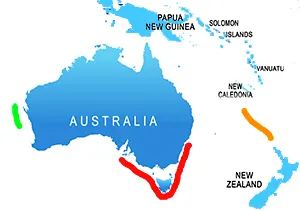
Photo: Blobfish Habitat Map
The blobfish lives in the oceans off the coast of Australia and New Zealand, at depths of 1,000 meters near the sea-floor. No sunlight reaches this deep ocean. As a result, there are no plants or other vegetation of any sort. The water temperature is just above freezing (2 - 4 degrees Celsius). Except for a rare photograph taken by a deep-sea rover underwater vehicle, no human has observed blobfish in their natural habitat.
Three types of blobfish are found close to Australia. Their habitats are colour-coded in the map. The Smooth-head Blobfish (Psychrolutes marcidus) is found off the coasts of southern Australia. The Western Blobfish (Psychrolutes occidentalis) lives off Western Australia. And "Mr Blobby" (syPchrolutes microporos) lives near Norfolk Island.
Blobfish Diet - What Do Blobfish Eat?
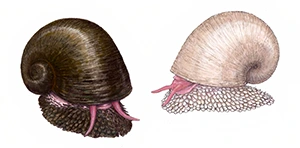
Photo: Snails and sea slugs are part of blobfish diet
The blobfish feeds on crustaceans, larvae, sea slugs, sea snails, sea urchins, and any dead biomass that drifts down from the ocean above. As a "lie-in-wait" predator, it spends most of its time floating motionless, waiting for food to come its way. When prey does pass by, the blobfish quickly sucks it into its enormous mouth.
Food is scarce in the deep-sea environment where the blobfish lives, so it has evolved to conserve energy. With a body that has few muscles, a low metabolic rate, and slow movements, the blobfish is perfectly adapted to survive on its limited diet.
Blobfish Reproduction & Life Cycle

Photo: Blobfish guarding its eggs
The female blobfish can lay up to 100,000 eggs in a nest on the ocean floor. Then she and her partner hover over the eggs to protect them from predators.
Blobfish Predators & Threats
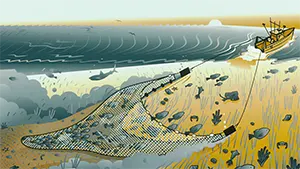
Photo: Deep-sea trawling captures blobfish
The biggest threat to blobfish is deep-sea trawling. Fishing nets cast to extreme depths unintentionally capture blobfish, which rarely survive the journey to the surface.
Because so little is known about the blobfish, we do not know if it has any natural predators or threats.
Are Blobfish Endangered?
The short answer is we just do not know how many blobfish are left in the world or if they are endangered. Some people claim that there are only 430 blobfish in the world. This is fake news and not based on any credible scientific evidence. The World Wildlife Fund and the International Union for Conservation of Nature (IUCN) do not list the blobfish as endangered.
So, the blobfish may be rarely seen, but there is no evidence that it is extinct or endangered.
Can You Eat a Blobfish?
Yes, you can eat a blobfish. But because its body is gelatinous (like Jell-O) and mainly made up of water, the blobfish tastes like a tasteless blob of jelly.
25 More Interesting Blobfish Facts
- The blobfish lives off the coast of Australia.
- It is a deep-sea fish that swims or floats at depths of 1,000 meters or more.
- The blobfish's body is designed to work under extreme pressure.
- Water around it acts as a container and compresses blobfish’s body into shape.
- For this reason, in the ocean, it looks like a giant tadpole. On land, it's a blob.
- The blobfish has no hard bones. Instead, its skeleton is made from soft, flexible cartilage.
- The blobfish has no teeth. So, a blobfish can't bite its food. It just swallows its food whole.
- The blobfish has hardly any muscle. Just enough to operate its gills, open its mouth and move its fins very slowly.
- The blobfish's low muscle mass and usage mean it uses very little energy.
- Only underwater deep-sea rovers can reach the underwater depth where the blobfish lives.
- Unlike most fish, the blobfish has no swim-bladder to keep it from sinking.
- Instead, its body is made of a gelatinous substance lighter than water.
- Because its body is lighter than water, it floats effortlessly at whatever depth it likes.
- It floats by adjusting the water content of the gelatinous mass in its body.
- By doing this, the blobfish makes itself lighter or heavier.
- It has no scales.
- It is not an active hunter. It waits for food to come its way.
- The blobfish female lays thousands of tiny, pink eggs.
- Nobody knows if the blobfish is endangered because so little is known about them and their population numbers.
- The blobfish named Mr Blobby was voted the ugliest animal in the world.
- Yes, you can eat a blobfish. But it is quite tasteless.
- Another sea creature that has a gelatinous body is the jellyfish.
- The blobfish has a lifespan of up to 130 years.
- Three types of blobfish are found in the oceans around Australia.
- The blobfish is not dangerous.